Richard Herrera and Richard Hardin in The Amazing Race Asia Season 4
FINALLY back to our regularly scheduled programming after quite a lengthy absence and some technical difficulties. Let’s start this year right with some of our thoughts about 2010. Sure, I know a good number of people (okay, myself included) who would say that it wasn’t exactly a great year for them from a personal standpoint.
Be that as it may, 2010 still gave us a good number of reasons to smile and be proud as a Filipino. There’s Manny Pacquiao, who clinched his nth world title by decisively defeating Mexican challenger Antonio Margarito. There’s singing sensation Charice Pempengco who had a memorable guest appearance in the top-rated musical series, Glee and pretty much stole the opening episode from lead star, Lea Michele. And while everyone did not agree with the actual outcome, the conduct of the country’s first automated elections was at least regarded by the majority of the voting populace as generally smooth and clean.
And then there’s Richard Hardin and Richard Herrera of Team Philippines who finally took home the bacon in AXN’s reality-based competition, The Amazing Race Asia. Since the show’s second season, Filipinos have always been regarded as the competitors to beat especially after the consecutive runner-up feats of previous participants. But it wasn’t until 2010 when our team finally made it all the way to the top.
As for the cable channel that brought TARA 4 and other exciting shows into our living rooms, winning has been pretty much everything for quite sometime now. With an average of 10.2 million viewers every month in Singapore, Malaysia and the Philippines from January to October 2010, AXN is once again the number one international channel in Southeast Asia.
Home to some of my favorite shows like the CSI franchise (Las Vegas, Miami, New York), Chuck, Numb3rs, Damages, Reaper, Criss Angel Mindfreak and the newly-rebooted Hawaii Five-O as well as reality sensations Top Chef, So You Think You Can Dance, Wipeout and yes, The Amazing Race Asia, among others, AXN continues to offer plenty of reasons to stay tuned.
The Malaysians certainly did as AXN beats its closest competing English network in by 24 percent in the primetime ratings. Out of the 14 first-run shows that AXN aired in 2010, 10 premiered at the top of the ratings chart. In Singapore, AXN is also ahead of all English pay-TV channels in Singapore in primetime ratings among cable 15+ audience, Ditto with us here in the Philippines as AXN leads in the English general entertainment category among cable 16+ audience, quite an impressive feat given the ultra-competitive nature of our local market.
Ricky Ow, Senior Vice President and General Manager of SPE-Asia, cites the recently concluded TARA 4 as one big reason for AXN’s success this year. Another is the remake of Hawaii Five-O starring Australian sensation Alex O’ Loughlin (Moonlight, The Back-Up Plan) as the new Steve McGarett and Scott Caan (Ready To Rumble, Ocean’s Eleven) in his recent Golden Globe-nominated role as Danny “Danno” Williams. Since its season premiere last November, the show has been a big hit particularly in Malaysia and Singapore.
The new Hawaii Five-O
“It is precisely because of the outstanding support from our Southeast Asian viewers, cable partners and sponsors that we have been able to expand our AXN family of channels, which today includes Animax, AXN Beyond, Sony Entertainment Television, as well as ONE,” Ow acknowledges. “With this expanded suite of channels, we will be able to cater to even more viewers, provide greater variety and deliver a diverse range of programs to suit the whole family’s viewing preferences. We have enjoyed a good year, and it is my promise to all our viewers that 2011 will be even more exciting.”
Well, I for one am looking forward to the fulfilment of that promise, especially since both AXN and my new HDTV-ready LCD TV are indeed giving me plenty of reasons to stay tuned.
So how did the M-150 Unleashed Northern Adventure Race went down? Well, read on.
The race
As the race progressed, the only way we were able to monitor how the other racers are doing was through hourly updates at WAVE 89.1. When our car radio signal became weak on certain areas, Paolo’s Manila-based sister kept us abreast with the radio updates via text messages.
It was there that we learned that Team Lighthouse Subaru, who breezed past us and other cars at the North Luzon Expressway misread the map, missed a crucial turn and ended up in Dinalupihan. By the time they turned back and barely made it to the checkpoint, almost two hours have elapsed and they just decided to bow out of the race and went straight to Subic.
They weren’t the only ones who had a hard time understanding the assigned routes. It took our own team a while to figure out the first checkpoint in San Fernando, Pampanga, which was only marked Essels and only by asking residents in the area were we able to figure out that Essels was actually a supermarket.
We made it to the first checkpoint in 30th place out of the 35 racers. As we made it to the succeeding checkpoints, we were encouraged by the fact that not only did we improve our standing at every stop, we were also aware of the difficulties the other racers were facing. Thanks to the updates of Paolo’s sister, we learned that some got momentarily lost while others had the expected car troubles.
Unlike those who were test driving vehicles for the first time (probably not a good idea for a lengthy race like this to begin with) the kid’s familiarity with his everyday car served our team in good stead. It also helped that his modifications turned out to be spot-on.
“The rims and the suspension are some of the factors as to why we did not end up with flat tires while negotiating the bad roads because putting race specs are not intended for rough roads, they are only used for flat smooth surface race tracks,” Paolo points out.
The big finish
As a passenger, I would have loved to stop at certain points for some photo ops and maybe even for some pasalubong items (after all, my intention was to merely cover the race) particularly in Baguio, one of my favorite places in the country.
But I could see from the fire in Paolo’s eyes that he intends to finish this race in a respectable manner at the very least especially when our standing kept improving with every checkpoint. From 30th place, we climbed back to 28th, then 21st, 16th, 11th and by the time we made it to San Fernando, La Union for the mandatory one-hour rest, we were already in ninth place.
As the race came down to the homestretch, we learned that Team P-1 Motorsports of driver JP Cariño and navigator Angelo Tambo, who led most of the way actually ran out of gas in the middle of the long and winding SCTEX. The grinding halt came just when the TIPO Gate (exit to Subic Bay Freeport) was already within their sight. They didn’t notice they busted their gas tank back in Checkpoint 9 in Tarlac. Team DKC of Arnel Carlos and Nino Sarte passed them by 20 minutes later.
As for us, we continued our progress as we finished 4th, 3rd and 2nd at the remaining checkpoints. By the time we entered Subic, we were already in a neck and neck pace with Team DKC. We somehow managed to shake them off shortly after entering Olongapo and yes, finished first ahead of everybody else.
We still lost the race, though. Maybe because Eslao is not an experienced circuit racer (many of the participants weren’t) or maybe because of his lack of familiarity with the time control concept (he was yet to be born when the last race of this type was held in the country), our team actually checked in early at the San Fernando, La Union pit stop that we were meted a stiff penalty equivalent to one hour and 15 minutes.
The decision
While that would suggest or imply that we did not follow traffic rules and was running faster than we were supposed to, the same could be said for the other racers who arrived earlier at that checkpoint, only they were smart enough not to “officially” check-in. Since that was allowed, I personally thought it defeats the purpose of the race’s whole safety first objective. Oh, well.
With an official time of 11 hours and 26 minutes with minimal or no penalties at all, Team DKC, who arrived second at the finish line, ran a clean race and won it all, including the P50,000 cash prize plus M-150 Energy Drink products, a special edition jacket and more importantly, bragging rights as the very first winner of M-150 Unleashed race.
“Our struggles included our car breaking down during the early part of the race going to the second check point at Bamban,” says Nino Sarte of Team DKC. “We had a busted CV boot resulting to the overheating of CV joint and busted axle. Despite all the troubles we still managed to finish the race at Subic.”
All told, it was a successfully-staged race and was exciting enough to merit a clamor for a similar race this year. Just like The Cannonball Run, this is one movie that deserves a sequel and talks of an even bigger M-150 Unleashed! (Southern Adventure, perhaps?) event have already made the rounds of the racing community.
As for Paolo Eslao, who by the way is based in the South, he is still very happy with how our team fared overall. “Well, we did finish the race,” he smilingly says with a sense of fulfillment. “With no accidents or mishaps whatsoever, we already achieved a great feat considering how hard we drove. Official or not, I think we owned them all.”
IN my line of work, I have been fortunate enough to travel in a lot of places. But for the life of me, I have never seen so many places in just one day. And that’s exactly what happened when I was invited to cover a cross-country race late last year.
To say that I got more than what I bargained for is an understatement. I have never experienced anything quite like it.
Still don't believe me? Well, here’s the first part of my account as published in Business Mirror's Personal Fortune magazine early this year.
LIKE A CANNONBALL
By EDWIN P. SALLAN
IT’S officially defined as “a point-to-point race against time, within the limits of the law covering 550 kilometers of North Luzon in a span of one day.” But for most of the participants, last year’s M-150 Energy Drink Unleashed! Northern Adventure Race might as well be the true-to-life equivalent of movies like The Cannonball Run and The Gumball Rally, the latter of which in turn was inspired by Gumball 3000, the annual international road rally that takes place on public roads with a different 3,000 mile route around the world each year.
Although a cross-country race on a much smaller scale, The Northern Adventure Race was still a first of sorts. Veteran race car driver Mike Potenciano, who helped organize the race and was among the participants said “the last time something like this happened here was in the early 1980’s.” Starting in Metro Manila at the Ortigas Home Depot, the race covers a total of 550 kilometers of the North Luzon grid and includes Checkpoints in Pampanga, Tarlac, Pangasinan, Baguio, La Union, Dagupan, Lingayen and finally its finish line in Subic, all within a span of one day.
It’s not as straightforward as it sounds, though. And racers who did not fully understand the rules ultimately paid the price for it.
The rules
The rules of the race were in conjunction with one basic objective: Safety above all and abide by all traffic rules, regulations and ordinances. This means breaking the law and reckless driving are highly discouraged and the organizers will not be responsible for those caught by traffic law enforcers.
Although the racers are allowed to pass through any route they want as long as they pass through all the controls or checkpoints, there are mandatory sections that all of them must pass through. Toll receipts may also be required as proofs of compliance.
Furthermore, to keep all the racers in line and ensure that the basic safety first objective is followed, a time control system with critical penalties was implemented. The starting order is determined by the order of entries who check in at the starting gate. Those who arrive early, leaves early with a one minute head start on the next car allowed to leave.
Each car must arrive at the given checkpoints at a given target time. Check in too early and the racers are slapped a penalty of five minutes added to his total time. Check in too late and a penalty of 10 will be added to their total, not as bad as being too early but can still be costly if the race comes down to the wire.
And yes, wearing of seatbelts are mandatory as non-compliance may also mean an additional one-minute per offense to the racers’ total time.
The racers with the best total time (finish time minus start time plus penalties, if any) wins the race.
The racers
This is where the rules start to loosen up. All road-worthy registered vehicles including all-wheel drives (AWD), four-wheel drives (FWD) and rear-wheel drives (RWD) with the exception of tube chassis are allowed to participate.
The rules require that racers race as a team with a minimum crew of at least a driver and a navigator. Since this was a long distance endurance race, preparation is key. And familiarity with the Northern Luzon certainly won’t hurt.
Team Dorifto with Ramon and Jonathan Arriola brought with them a 20-man strong pit stop crew and actually acquired a brand new Honda Accord just for the race. The heavily favored Team Lighthouse Subaru of race car driver Pia Boren and advertising executive Ianne Borillo were packed with essential supplies.
Another favorite, Team Mazda of Mike Potenciano, his co-host, Lindy Pellicer of radio station WAVE 89.1 and navigator Steve Cheng were test driving a Mazda 6 for this particular, the same with Team MetroMag of Stef Juan, Camille Aguilar and Andre Tani who are also trying out a Toyota Prius.
Other noteworthy cars in the field of 35 teams included the Mitsubishi Triton of Team Fast and The Curious, the Volvo V50 of Team Big Head, the Mercedes Benz of Team Sprocket Benz, the Mitsubishi Pajero of Team Capture, the Nissan Silvia of Team Esguerra and the Honda Civic LXi of Team P-1 Motorsports.
The dark horse
This writer ended up being assigned as the navigator (!) for Team Paullex of 21-year old Paolo Eslao, the young proprietor of Eurocon Trading, an automative and industrial airconditioning parts business that he started when he was only 19 years old. The unheralded kid, who very few have heard of prior to the race entered his own mom’s Ford Lynx 1.6 GSI, the car he drives everyday to school and work. Paolo originally wanted to race alone but was forced (reluctantly, if I may add) to take me as navigator to comply with the rules.
Eslao’s preparation for this race was the most impressive in my book. Driving at go kart race tracks since he was 14, he spent his high school years in the Netherlands and further honed his driving skills in those long, European countryside roads.
If that’s not enough preparation, he studied Automotive Technology which partly explains his knowledge of the strengths and weaknesses of the other vehicles. His knowledge of cars also helped him modify his own car in accordance to “what is only needed for it to run on bad roads.” And for him, that meant lowering springs in his suspension and replacing parts in the engine (intake, headers, exhaust) for better air flow that in turn translates to more power and reliability.
And of course, since he did not intend to race with a navigator (and I doubt if I could really be a big help in that area since I neither race nor drive), it certainly didn’t hurt that he has a GPS device with him, which by the way, was not against the rules.
THANKS in large part to their now celebrated soccer team’s Cinderella runner-up finish in the recently concluded World Cup, the Netherlands are making waves again. Well, their national soccer team actually are not the only pride of this otherwise low-profile European nation.
Back in 2007, I had the chance to interview Niels Fiejen, one of the best pool players in the world who only recently placed second in this year’s WPA World Eight-Ball Championship. Three years ago, Fiejen was in town not as a professional pool player but as a DJ who headlined a series of gigs not surprisingly called The Cue Sessions.
And here’s how my 2007 encounter with this multi-talented guy turned out as documented by an article I wrote for the Manila Bulletin back then.
THE TERMINATOR
By EDWIN P. SALLAN
ONE way or another, Niels Fiejen knows how to kick butt.
Well, anyone who goes by the moniker The Terminator should know a thing or two about blowing whatever competition comes his way. As a pool player, this incredible Dutchman is simply one of the world’s best, being a member of the same Mosconi team that consists of the best European billiards champion. He is also one of the very few who could lay claim to beating our very own Efren “Bata” Reyes in his own game. As a matter of fact, it was that particular feat that pretty much made his “Terminator” reputation.
“I’ve always been a pool player first and foremost,” he declares. “This game has taught me so much about my personality, my weaknesses and my strengths.”
But Niels admits that his lifelong passion for this particular sport also started at the same time his love for music started. “I was 17 when I started playing pool and it was right about the same time when I bought my first record.”
By 18, Niels was already a DJ “on the side.” “My dad had a CD player with pitch control and a turntable with pitch control by coincidence,” he recalls. “A friend of mine had an old mixer at home which I could have and that was it, I was hooked.”
Niels was a resident DJ in a club called “de Kleine Kunst” in his native Holland for a year and a half (“but only when he’s not playing pool,” he insists) and thrilled patrons there that would number as many as 400 in virtually the same way he dazzled pool fans with his signature moves. As recent as two years ago, Niels was a featured attraction in another hot club called “One Four” in his hometown, The Hague. Here, he will be headlining a series of parties called The Cue Sessions, obviously as a double reference to both his passion for DJ’ing and his background as a pool player.
“As my style kept on developing through the years, I found the ones that I like the most in progressive-house, tech-house, deep-house, house and a little techno,” he reveals. Unlike his celebrated compatriot, Armin van Buuren who was actually in town just a few weeks ago, Niels is not a big on trance. “Everything but trance,” he stresses.
Perhaps the most impressive thing about this guy’s DJ’ing style is that there is nothing complex about it. The guy just keeps everything simple. “Whether it is a pumping beat or nice vocals, whatever makes me move, I got to buy and spin,” he exclaims. With a spinning speed that “lies between 126 to 136 beats per minute,” his sets have a way of telling everyone to “just shut up and dance.” His own mixes (Spring, Summer, Fall and Winter ’06 and “07) that anyone can personally download can attest to this.
It also shows in his candor. Niels is not the type of DJ who tries to impress people with a supposedly vast knowledge of music and genres. He doesn’t dazzle interviewers by mentioning musical influences that no one’s ever heard of. He admits to listening to “regular hit music, slower music, Top 40, reggae, house, the 80’s, Maroon 5, Keane, Coldplay, Blues Traveler, you know, everything really.”
This is probably what makes him just as adept at the turntable as he is with a cue stick. One way or another, Niels Feijens does really know how to kick butt.
IT’S back. Well, at least now filming is season 4 of The Amazing Race Asia. Dubbed as Asia’s most highly anticipated and long-awaited multi-continental race, AXN Asia says the new season expects to “up the intellect ante with the most sophisticated demands on top of the already tough challenges the race will impose on contestants.”
Hoping to repeat the sheer excitement and intense moments of adrenaline rush of previous seasons, TARA 4 features 10 teams of two dashing across countries and oceans to areas AXN Asia describes as “off-the-beaten-tracks” and “exotic spots” all for the chance to win impressive pit-stop prizes from sponsors like Sony and Caltex and of course, the grand prize of US$100,000.
Which also gives me a good reason to revisit a 2008 feature profile for the Manila Bulletin that I wrote on Vanessa Chong (left), one-half of the TARA 2’s surprise runner-up finishers. I’m not exactly sure whatever happened to the pretty Malaysian who made quite a big splash here after her impressive TARA feat with her sister Pamela (right). Perhaps reposting this slightly revised version will lead to some updated information? Well, there’s only one way to find out. Read on.
AMAZING CHICK
By EDWIN P. SALLAN
IF there’s anything we learned from the second season of The Amazing Race Asia, it’s that looks can be very deceiving. In the case of Malaysian sisters Vanessa and Pamela Chong who eventually finished as the surprise runner-ups to the equally surprising and partly-handicapped Singaporean champs, underneath the knockout prom queen exteriors are two highly competitive individuals who never underestimated any of their competition.
“It didn’t feel like we lost at all,” declares Vanessa Chong in recalling their overall experience in AXN-Asia’s top-rated reality show. “Our goal was to make the top three and the fact that we were able to do that made us feel like winners already because being in the top three means you finished the race and we did.”
In a competition that was just as much as about brains as it is about brawn, the sisters showed they did possess the kind of physical and mental toughness needed to go the distance. Vanessa, who was recently in town to promote the popular Malaysian cosmetics brand Elianto says she and her sister never cracked under pressure. Not even when they were shown to be arguing heatedly in the car when trying to find their way to a pit stop. “No, we never actually fought,” she insists. “It’s really just the way we talk. We never lost sight of our goals and we’re really too close to be worried about how this race would affect our relationship.”
And certainly not even when Vanessa momentarily lost her memory for a good 15 minutes during a diving board task that saw her plunge into the water a little too deep for comfort resulting in a lump in the head. Even at that scary moment, younger sis Pamela did not totally lost her composure as she still managed to keep their team in the race until Vanessa fully recovered.
As the eldest of six siblings, Vanessa has always been there for the rest of the Chong brood. A real tough cookie even when she was still at school, Vanessa was a constant gold medal awardee for sporting and non-sporting contests and was even honored as sportswoman of the year in high school for winning in decathlon events including shotput throwing and the 100-meter dash.
A renaissance girl of sorts who also excelled in other school activities such as children’s plays that she herself wrote and not just acted in, Vanessa was also a mainstay of choir along with Pamela and brother, Vince Chong, a popular singing sensation in Malaysia who recently scored hits performing songs from High School Musical, the hit TV movie franchise of Disney Channel.
And even though the drop dead gorgeous Vanessa has always been worthy of the spotlight herself, she didn’t mind taking a backseat in favor of any sibling who needed her support. Prior to joining the race, Vanessa was actually managing Vince’s career and putting the Marketing Administration degree she earned from the UK to very good use.
“I loved working behind the scenes for my brother,” she says. “I handled his schedule, was always there for each of his shows and negotiated his deals. And let me tell you I can very tough when it comes to business.”
Vanessa admits that she’s had her share of hosting affairs but started turning them all down because “I really wanted to concentrate on managing my brother’s career.”
So when she and Pamela decided to give The Amazing Race Asia a shot, Vanessa made sure that everything would be all right for her brother. “I made sure his schedule is all fixed up and left everything with my assistant. Vince is a good boy who concentrates on his art. I think not being on his side made him more independent.”
Not that Vanessa needed to worry about her brother but she says the very fast pace of the race could not really afford her to think about anything else. “Back then, the race was our reality,” she recalls. “Our whole life revolved around it and there was no time to miss anyone and focus on other things. The race is all we thought about.”
It all paid off with that impressive runner-up finish and the corresponding doors that opened for Vanessa and her sister immediately after. In the race’s aftermath, Vanessa was featured in one of the new commercials for Sony Cybershot cameras. And then there’s the image modelling gig for Elianto, a brand that she already uses long before she was asked to endorse its products.
Given how well she has done for herself at this stage of her life, what Vanessa Chong has so far achieved is simply nothing short of amazing. When asked if she and Pamela would take part in The Amazing Race Asia again, the equally feisty Pamela was very firm in saying, “In a heartbeat!”
“The memories, the adrenaline, the whole experience is something that money can never buy. There’s no way we won’t do it again given another chance,” Vanessa concludes.
HERE’S a slightly tweaked version of a 2007 article I wrote for One Philippines magazine, written while I was covering an event in Boracay. I actually did the legwork for this multi-source piece before I left but for some reason couldn’t get it together. Found some idle time and a cheap internet café in Bora and to paraphrase Randy Quaid in The Paper, it wrote just like butter.
Can’t remember how the article was edited but this was an improved version of my original draft. Modesty aside, I’d like to think I hit a knockout punch with this particular piece. Well, you decide. Read on.
Photos courtesy of Ringside boxing gym.
GOING THE DISTANCE Or why boxing gyms in this country are not just for Manny Pacquiao wannabes
By EDWIN P. SALLAN
ALTERNATIVE is a word that is often tossed around by its evangelists. Multimedia personality and sexy fitness buff Chinggay Andrada swears it’s “the safest way to release and relieve stress.” And at least one sought-after venue has employed the tagline, “Get fit without getting hit.”
Who would have thought that boxing, a sport that is widely regarded by naysayers as violent, barbaric and in the words of an American Medical Association official, “an obscenity that should not be sanctioned by any civilized society” has reinvented itself in such a way that many are now using it in the same sentence as the words, “health and safety?”
The reason, of course, has more to do with getting fit than getting hit as boxing gym Tiger City succinctly puts it. The idea, according to rival Red Corner Fitness and Boxing Club, is “to build boxing up not only as a serious sport to get into but also as a good way to get into shape.” Marketed as a form of workout and leisure sport, it’s not surprising that there’s even a new term for it: Fitness Boxing.
“I believe the sudden emergence of boxing gyms or boxing workout nowadays is that people are looking for an alternative workout that is not only effective but also exciting, fun, and challenging to do,” says Tom Noda, an IT journalist and a regular at Tiger City. “A boxing workout gives you that because the drills deviate from the ordinary general fitness programs. For instance people tend to enjoy boxing drills like punch mitts, wherein a trainer holds two punch pads as target and makes you to do a variety of combination punches and other boxing moves.”
Ianne Borillo, one of the owners of another boxing gym called Ringside, located in most Gold’s Gym branches, agrees. “I think people just got bored with merely ‘gymming’,” she notes. “There was this need for alternative means of drastic weight loss and cheap workout. Then there was the media and then Manny Pacquiao and the rest, as they say, is history.”
Yes, the popularity of Pacquiao, our “pambansang kamao” certainly does not hurt. But as each of these guys would attest, most of those who sign up for these boxing gyms are not there because they aspire to be the next Pacman. A good number are actually in it for the health benefits, of which there are numerous, Ianne enthuses.
“Boxing is one of the most effective workouts for weight loss, endurance and speed development,” she says. “It improves your mood by increasing your brain and body’s blood supply and oxygen so you can think more clearly and have better dispositions. It helps counteract depression and premenstrual tension in women by decreasing salt retention caused by high hormone levels. It improves deep sleep, increases your feeling of accomplishment and confidence and as a whole is a great source of wholesome recreation and avenue for inter-personal development.”
A former instructor herself at Red Corner, Chinggay says boxing actually saved her life. “You know, ever since I took to the sport, it has greatly improved my reflexes and lessened my injuries,” she admitted to this writer in an earlier interview.
Along with Elorde Boxing Gym, it was really Red Corner that kick-started the fitness boxing phenomenon in the country. Other boxing gyms that have mushroomed since then include those with names like Wild Card, Total Knockout, Chinggay’s own Punch Club and of course, Ringside and Tiger City.
Just how popular are these boxing clubs in the country? Well, Ianne says the central gym of Ringside at Gold’s Gym Alabang alone has already 2,500 members to date, of which around 45 percent are very active. “We average 60 students per day and 30 new members sign up every month,” she says.
Since it opened in 2004, Tiger City, on the other hand, now has 800 members. With Pacquiao’s recent victory over Barrera, Tom expects membership not just in Tiger City but in just about every boxing gym, to shoot through the roof.
As relatively new gyms, both Ringside and Tiger City offer more diversified programs to give them an edge over the existing and increasing competition.
“We at Ringside offer beginner, intermediate and advanced programs based on the scientific advancement of fitness,” Ianne muses. “They essentially consist of boxing, Muay Thai kicking, plyometrics and circuit training under a group atmosphere. We do not expect our clients to know these scientific methods right away so when they step into the gym and go through with their workout, we are there guiding and motivating them every step of the way.”
“The usual programs at Tiger City are the boxing training itself, which includes shadow boxing with or without dumbbells, punch mitts, heavy bag, floor to ceiling ball, speed ball, skipping rope, matt exercises, stretching exercises, and for those who are up to it, sparring sessions. Also running and weights too,” Tom offers.
The proper stance, hand and foot position and getting your lower body involved are already taught in these programs. To avoid injuries, it is important to remember not to let your guard down whether you’re sparring or simply taking jabs at the punching bag, as Chinggay keeps pointing out.
So who can get into the sport and what would they need? Tom says “young or old, male and female can train.” “For those with health problems, they should show proof that their doctors are allowing them to do the workouts,” he adds. “But usually, the level or intensity of workout varies from age and sex, in the case of children, women and senior citizens.”
Both Tom and Ianne are one in saying that interested parties need to invest in at least their own boxing gloves and handwraps that are usually free for trial sessions only. Those who wish to engage in sparring should also invest in their own mouth guard or mouthpiece as headgears are already available in the gyms.
For her part, Chinggay stresses that those who want to get into the sport should be in it for the long haul and not just jump into the bandwagon as results are not going to be achieved overnight. “You have to look at this as a commitment,” she emphasizes. “For my part, I’m more interested in climbing a mountain, Mt. Everest to be more specific, than fitting in a size 2 dress.”
Ringside is located in most Gold’s Gym branches including the ones in Glorietta and Alabang Town Center. Tiger City is located at 145 San Francisco St. and at 248 Sto. Rosario St., Plainview, Mandaluyong. Elorde Boxing Gym and Red Corner Fitness and Boxing Club have several gyms in Metro Manila.
TWO years ago, I got the chance to contribute two articles to Silver Lining, a Singapore-based lifestyle magazine that specifically caters to the 45-64 “Silver Age” market as their editorial team so emphatically refers to it.
Last November, I already posted one of the articles I wrote for this publication on the netbook phenomenon. Now that the latest auditions for the much anticipated new season of that acclaimed AXN reality competition show, The Amazing Race Asia has recently concluded, I thought it was the right time to post something I wrote about two of its previous participants.
This 2008 piece is actually the fourth feature story I have written on certain Amazing Race competitors since its first season. My first piece on The Amazing Race was the one on its Season 7 winners, Joyce and Uchenna, who I interviewed on the phone following their victory. I also profiled TARA 2's Vanessa Chong as well as the celebrated team of Marc Nelson and Rovilson Fernandez, who won the most pit stops that same season.
NOTHING SHORT OF AMAZING Silver Age amazing racers Henry Chan and Ida Nerina prove that it’s never too late to go for gold.
By EDWIN P. SALLAN
IT was supposed to be the toughest race ever. The challenges among others included consuming large bowls of assorted fried bugs, frogs and scorpions; completely clean a dirty 22-seat passenger bus; fill a bucket full of water at the top of a mountain to a monk’s satisfaction; perform a bungee job from the top of Macau Tower; wash and clean a stinky live elephant; and move 10, yes 10, camels into their holding pen.
Those of us who are merely watching the top-rated reality competition series, AXN-Asia’sThe Amazing Race Asia are convinced that such challenges are certainly not for everyone, much less for those who are already in their Silver Age. Well, Henry Chan and Ida Nerina, both in their swinging 40’s thought otherwise. Forming one half of two Malaysian teams, both Henry, a chef by profession and Ida, an actress slash producer slash director signed up for the show's third season and ultimately surprised both viewers and their younger competition alike with their very impressive showing in the race.
Breaking the age barrier
“Age has never been and will never be a factor that holds me back,” Henry declares during an exclusive interview with this writer for Silver Lining. “For as long as I am healthy, I see myself being able to do anything I put my mind to.”
Ida agrees. “Uh, what's wrong with my age?” she protests half-jokingly in the same interview. “I mean, quite honestly, I’m in this industry that is so unforgiving about age that truth be known, I didn't even think of it. I saw it as a race and I want to race. That seems to be the only thing that I can imagine would prompt someone to fill out those lengthy application forms.”
With teammates who are also pushing 40 (Henry teamed up with sister Bernie, a well-known TV host in Malaysia while Ida’s partner and best friend, Tania, is a property developer there), both were not at all deterred by the physically and mentally tough nature of the race that took them on a grueling 11-week tour in Thailand, Vietnam, Taiwan, China, India and Oman. And they came prepared.
Ready to rumble
“Toughest race ever, they say? My teammate Bernie and I thought, ‘Bring it on’!” says Henry, who admitted to already being physically prepared even before joining The Amazing Race Asia 3. “I am a reasonably fit person anyway. I eat well and I exercise a lot. Prior to the race, I just upped the amount of cardio work I did at the gym. As for mental preparation, there wasn’t any at all. What you saw was us running on pure adrenaline!”
“I've been practicing yoga for the last seven years so I guess that helps,” Ida reveals. “It keeps you centered, you know. Mentally, I suppose Tania and I had agreed to just appreciate the fact that we're in the race and experience every emotion of the trials and tribulations that come with it, the pain or the pleasure. As for regimen, I just picked up my cardio and strength training after the audition just in case we were selected.”
Henry’s team was very competitive throughout the race, especially during the early stages. They were in fact considered by their rivals as the team to beat after winning two Pit Stops and placing second or third on three other occasions. They eventually got eliminated in Week 9, placing fifth overall. Ida’s team did better, lasting all the way to the final leg of the race before eventually settling for third place on what has turned out to be a rollercoaster ride punctuated by two Pit Stop victories and two last place finishes in, fortunately for them, non-elimination rounds.
Looking back, both Henry and Ida now marvel at how their participation in their favorite TV show has changed their dispositions in life.
An experience to remember
“The Amazing Race Asia was one of the most powerful experiences I have had in my life,” Henry beams. “Watching it now is like re-living a dream I once had.”
“It may not have changed my life per se, but it's probably one of the most fun yet best experiences for my self-esteem as in ‘I did it!’,” Ida adds. “The Amazing Race Asia is probably the only reality TV show that I truly follow. I actually forget that it is a reality TV show. I was a couch potato criticizing what when how and I am now one of 60 racers of this great show and I think we did very well if you’re going to say that age is a factor.”
These days, both Henry and Ida are back to their usual routines. Henry says he will resume his food consultancy business while also currently writing and developing food and travel shows for Malaysian TV. Opening a restaurant in New York is also part of his future plans. Ida, on the other hand, has a few acting projects in the pipeline for next year.
With no signs of slowing down, the two are both one in saying that age should not dictate how you should live your life and it should never be a hindrance in the pursuit of one’s dreams.
“When you start living life worrying about so-called ‘age-related concerns’ you will naturally start making this a reality,” Henry points out. “My advice: 1) never think of yourself as old or middle aged but rather experienced and well lived; 2) have a go and try to do anything and everything that you’ve always wanted to do and 3) if anyone tells you you're too old or implies that you have to behave a certain way because of your age, tell them to shove off because you don't buy it!”
The effervescent Ida has a more tongue-in-cheek way of putting it: “You know what? We'll all get old and wrinkly but truth is, it's probably other people's perceptions of age that will age you. So let your hair down and if you don't have much hair, well, get extensions!”
SOMETHING I wrote for GARAGE magazine last year. Slightly revised and updated. Yes, believe it or not, it's actually a lot safer than it looks.
And for a first hand look or experience, you might also want to check out the upcoming 2010 Balayong Festival Offroad Challenge in Puerto Princesa City, Palawan this coming March 5 to 7, 2010. Interested? Then please check out Mike Potenciano’s Facebook page and drop him a line.
MONSTER TRUCK MADNESS
By EDWIN P. SALLAN
WHEN people think about races, they usually think about fast cars running at breakneck speed. That’s not necessarily the case with off-road vehicles particularly those imposing 4 x 4 monster trucks. Or so says veteran race car driver Mike Potenciano who organizes these type of races along with a couple of other similar off-road rallies and veteran jet ski racer turned 4 x 4 off-road racing champion Joey Millionado.
“Off-road racing is only one of several types of off-road races that I organize here under my group, MP Turbo,” says the multi-awarded Potenciano, whose racing experience spans many years of competitive racing in varied disciplines—from karting to rally cars to touring cars to Formula One cars, name it, he has done it. “There are actually several variants of off-road racing including the faster 4 x 4 Speed, Motocross and Moto Enduro, Mountain Bike races and Rally Raid.”
Now 47, Potenciano remains a racing icon and a unifying force in what was once a dormant industry during the martial law years. An industry that was only revived during the late 80’s. When he’s not organizing races, he races himself and when he’s not racing, he organizes them. He also continues to aggressively promote the sport through his television show called SpeedTV that airs on the Viva Prime channel and Turbo Time, a radio show that he co-hosts with DJ Lindy every Monday from 10PM to 12MN at MTV Radio U92.3 FM.
Although he has a strong preference for the faster and yes, more dangerous variations of off-road motoring, he is nonetheless actively involved in promoting the slower but equally exciting 4 x 4 off-road racing.
“The thing about regular 4 x 4 off-road racing is that it’s actually safer than other motor sports,” quips Millionado, also 47, and a longtime friend of Potenciano’s. “You’re only running on first and second gear only or 40 kph an hour at the most. Yes, your vehicle will have its share of tipping overs but the only thing you need to do when it does is to just hold on to the steering wheel and you should be okay. Injuries are very rare in these kinds of races.”
Millionado, who owns Joey’s 4 x 4, a motor shop that specializes in modifying 4 x 4 vehicles, particularly Suzuki Ferozas, for both hobbyists and racers says the key to winning these kinds of races is how light one can modify his own vehicle or “rig.” These rigs are not built for speed to begin with and for off-road racing, they don’t have to be. “An unmodified Suzuki 4 x 4 usually weighs 800 to 1,000 kilos and modified to 600 to 800 kilos should do well in these types of races.”
Aside from Suzukis, the Toyota Land Cruiser (the 40 series variant) is also a popular choice for off-road racing. In terms of modification costs, Millionado says a budget of P500,000 should be enough to get Suzukis to rock and roll while Land Cruisers are more expensive to modify with an ideal budget of between P800,000 to P1.0 million. “From there, it’s non-stop gastos na as every race you participate will require your vehicle to be regularly maintained and even further modified.”
And then there’s the matter of the man-made tracks, which he says are actually more difficult than the ones in the international circuit. “Every track that we race here like the off-road tracks in Tiendesitas and the Fort are not the same unlike in the races held in the rainforests of Malaysia where it’s easier to familiarize with the tracks after racing there a few times since the course doesn’t change. Our races are shorter, usually about 15 minutes, but far more difficult.”
More than his own achievements, Millionado is proud of his teenage daughter, Jam, who is already a rising star in the off-racing circuit. “She already knew how to jet ski when she was just three years old,” he beams. “She started driving at 13 and at 16 ran her first race where she placed second and has been doing well ever since.”
Potenciano says the faster 4 x 4 races require vehicles to shift up to 3rd and 4h gears. Among the many off-road races that he has organized, he is particularly excited about what he dubs as The Ultimate Speedfest Championship which combines 4 x 4’s and motocross. “It was a big hit with the locals in Puerto Prinsesa when we organized it last March,” he muses. “We’re planning to do Rally Raid or Dakar Type Rallies with 4 x 4’s, rally cars and motorcycles.”
As defined in Wikipedia, Rally Raid, also known as cross country rallying is a more ambitious form of long distance off-road racing that takes place over several days. Each day may require traveling up to 900 kilometers. The length of the event can be 3–15 days. Examples of rally raid races include the Dakar Rally, Central Europe Rally, Spanish Baja and Russian Baja Northern Forest.
The one MP Turbo plans to organize here covers about 300 kilometers and as Potenciano himself describes it, is “extreme and high-speed.” Aside from Puerto Prinsesa, other popular out-of-town destinations for off-road races include Pampanga and Bicol.
Both Potenciano and Millionado are one in saying that off-road racing is now a very popular sport in the country and with a very bright future to boot. “While not everyone can be racers, afficionados of the sport can still be a big part by helping out as marshalls, managers, organizers and mechanics,” Potenciano says. “Do you know that we have the best mechanics in the world here in the Philippines? Unfortunately, they are just being pirated by other countries. Their participation is actually key in the success of the speedfests that we organize.”
BACK in 2006, Tracy McGrady or T-Mac as he is fondly referred to by fans was one of the world’s best basketball players, an A-list superstar that’s right up there with the likes of Kevin Garnett, Tim Duncan, Allen Iverson, Kobe Bryant and his own cousin, Vince Carter.
But a series of back, shoulder and knee injuries hampered the rest of his career from thereon and even when healthy enough to play, T-Mac never took any of his teams including the Orlando Magic and the Houston Rockets beyond the first round of the playoffs.
Fast forward to 2010, T-Mac is the highest paid NBA player in the league’s current season with an expiring US$23 million contract. But his inability to bounce back from microfracture knee surgery has forced his team to put him on the trading block. Even though he insists he’s regaining the form that once made him a force to reckon with above and below the rim, the Houston Rockets thinks his comeback progress has been slow and refused to grant him the additional playing time he wants.
So until he’s traded to a new team or his contract finally expires at the end of the season, T-Mac is on an extended leave of absence. The Chicago Bulls, the New York Knicks and the Miami Heat are interested but until a team picks him up, McGrady’s immediate future, at least for this year and as of this writing, remains uncertain.
But back in 2006, he was pretty much at the top of the world and at the top of his game. An extended tour of Asia to promote his then much-coveted Adidas T-Mac 1 shoes allowed us here in Manila to see that for ourselves.
And here’s how I remember Tracy McGrady back then:
T-MAC TAKES MANILA BY STORM ANEW By EDWIN P. SALLAN
IT was quite the second coming indeed.
Tracy McGrady or just plain T-Mac was back in Manila again. Yes, one of the world’s best basketball players who took Manila by storm six years ago was recently in town for a four-city Asian tour to launch and promote his latest basketball shoes and clothing line made by adidas.
There were several activities lined-up for T-Mac during his two-day sojourn here, the highlight of which was the launch of the adidas Limited Edition T-Mac 1 held at the Music Hall of the SM Mall of Asia.
Not even a slight drizzle could turn away the full house crowd that came in droves to get a glimpse of the 27-year old Houston Rockets forward whose game is defined by silky-smooth moves and strict adherence to team spirit. T-Mac is the only professional athlete to sign a lifetime endorsement deal with Adidas, the athletic footwear manufacturer responsible for definitive basketball shoes worn by other NBA greats like Jerry West, Kareem Abdul-Jabbar, Tim Duncan and Kevin Garnett.
When T-Mac finally emerged from a slowly rising elevated platform, it was such a glorious sight for fans that kept chanting his name over and over again. Visibly overwhelmed by the very warm reception, T-Mac can only exclaim, “Mabuhay, Philippines! It’s great to be back!”
A much-awaited portion of the show was a mini-shooting clinic conducted by T-Mac himself for the Future T-Macs of The World. These are two groups of kids who are in their pre-teens and teens that dazzled T-Mac with their respective basketball abilities. T-Mac has always said he’s impressed with the way Filipinos played basketball. He was, however, particularly amazed with the ball-handling abilities of a couple of 12-year old boys.
“I couldn’t handle the ball that well when I was their age,” he enthuses. “These kids are way ahead of schedule. They’re ready.”
Teaching kids the proper stance and posture for shooting free throws and three-pointers, T-Mac enjoyed every minute of his brief clinic as he dished out assists, shot free throws with his eyes closed and gave high fives to those who made their shots. He even brought the house down when he performed a spectacular back-to-the-rim slam dunk that elicited more than its fair share of jaw-dropping oohs and aahhs.
As a player, T-Mac prides himself as someone who can play more than one position in the court. “I am a versatile player,” he declares. “I’m a player who is not one dimensional, someone who can do it all - pass, rebound, play defense, get my teammates involved, just do it all.”
T-Mac’s ideal game-winning scenario would go something like this. “I just ran off 15 straight points to put our team back into the game,” he narrates. “We are down by one and there is about 10 seconds to go. I have the ball and I am isolated at the top of the key. I break my man down and the defense collapses on me. I kick it to one of my guys and he hits a three, and that is the ball game.”
When asked how he’d like to be remembered for when the time finally comes to hang his jersey, T-Mac’s reply was very emphatic. “On the court I want to be remembered as a great player and winner. Off the court I want to be thought of as a great person with a great personality, a humble person.”
With his equally warm demeanor and dazzling display of basketball prowess, T-Mac showed why he is the personification of adidas’ popular tagline, “Impossible Is Nothing.” It was indeed quite a second coming.
And here's one of T-Mac's greatest performance ever:
FROM 2005 to 2007, the Discovery Channel aired a documentary series about the life-threatening experiences of ordinary people that were faced with incredible circumstances as actors re-enact their stories.
One of the series’ more memorable episodes featured three British climbers that got caught in a snow storm in Alaska's Mt. Mckinley, dubbed as “The Great One” and arguably one of the toughest peaks in the world. I was fortunate enough to be offered a telephone interview with Nigel Vardy, one of those climbers and now I’m reposting a slightly revised version of the article that was first published in the i Section of the Manila Bulletin back in 2007.
Although I Shouldn’t Be Alive has since been discontinued, re-runs are still being shown at both Discovery Channel and sister channel, Animal Planet as part of its Discovery Classics series. The entire series is also available on original DVD.
Having survived the toughest of odds, Nigel Vardy is back in “peak” form and all set to reach new heights anew.
By EDWIN P. SALLAN
EVEN the man himself thinks he shouldn’t be alive today.
Celebrated British mountaineer Nigel Vardy has successfully “lived through” the jungles, waterfalls and mountains of Chile, Guyana and Bolivia but he will be the first to admit that no amount of training and mountaineering experience has prepared him for his toughest challenge yet: Mt. Mckinley.
“Though not the highest mountain in the world, Mt. McKinley ranks as one of the hardest to climb,” Nigel wrote in an article posted at his website. “Its difficult approach and unpredictable weather makes it one of the biggest challenges in mountaineering. It stands 20,320 feet above sea level and dominates the Alaska Range of mountains. First climbed in 1913, McKinley still proves to be a difficult challenge. In 1999, 1183 climbers attempted the climb with 508 reaching the summit—a success rate of only 43 percent.”
Given its degree of difficulty for most mountaineers, I couldn’t help but ask Nigel himself during a recent long distance phone interview what attracted him to Mt. Mckinley to begin with.
“Mt. McKinley is a very magical mountain in the mountaineering world, because of its northernly location and some of the legendary climbs and stories that you hear,” he notes. “It’s one of those special mountains that many, many people want to climb. I had looked at the mountain, but never got an opportunity until, particularly Steven Ball, who always wanted to climb the mountain, was talking to Anthony Hollinshead. I know Anthony from many years ago, and the idea was put to me and I accepted the climb.”
That was during the autumn of 1998. Six months of planning, commitment and training on the part of Nigel, Anthony and Steven followed. By April of 1999, they were ready for McKinley. Or so they thought.
By Nigel’s own account, it took them six days to reach the base of the mountain alone after negotiating a good eleven miles of glaciers that are not without their share of crevasse. “Crevasses are deep cracks in the glaciers surface and can be hundreds of feet deep,” he points out. “To fall down one can mean severe injury or even death.”
Reaching the base of Mckinley is not nearly half the battle won. Further obstacles include “a 1,200 ft gulley of snow and ice followed by undulating snow and rock ridges.” And then there was the weather. Due to its high latitude and its proximity to the jet stream, the mountain is also characterized by an unusually severe risk of altitude sickness and extremely cold weather.
Even with all these odds, Nigel and company made steady progress during their 17-day climb and were actually a few hundred yards from the summit. That’s when the “ferocious winds and below freezing temperature” took over and it was simply impossible to continue. It was certainly not encouraging to be told over the radio that rescue is still a good two to three days ahead.
“I suffered quite severe frostbite, losing all of my toes, the backs of my heels, all of my fingertips and my nose, which ended up being amputated or fell off,” he recalls.
Anthony and Steven also suffered from frostbites and hypothermia but all three of them were rescued just in time to cheat death. How they managed to survive is now the subject of Frozen At 20,000 Feet, the premiere episode of the acclaimed Discovery Channel series, I Shouldn’t Be Alive.
The series showcases the world’s most incredible stories of survival, displaying people’s innate drive to live—even in the most unimaginable situations. Told in the present tense with a mix of high-caliber dramatizations and first-person interviews, each episode is told from the perspective of the survivor. Advanced graphics provide practical information about survival and reveal what happens to organ functions and the human body as it faces extreme challenges in harsh environments.
Asked why he agreed to share his near death experience with the world when it was an ordeal that very few would like to relive all over again, much less talk about, Nigel says it wasn’t an easy decision.
“I think initially I agreed with it, because it’s a good story to tell, and I think it’s a story that people can learn from and gain knowledge from the experience,” he says. “Also, I’m a storyteller. It’s one of my things in life, so I do rather enjoy that. It was very, very difficult for me, though. I don’t know if you’ve actually seen the documentary yet. But the interviews that were done with ourselves in front of a camera, we’re going through the actual experience for something like eight or nine hours of questions. And mentally, that was quite hard. You don’t revisit it as hard as that or as long as that, in fact, I don’t think I had since the accident itself.”
“I remember going through the interview being physically and mentally exhausted and driving home that night and just going to bed. I couldn’t even face staying up. I was so tired and for a couple of days, I was very quiet. I go quiet when I start to think. And I found it quite hard to deal with although I thought it was worthwhile. I think occasionally, it is good for you to revisit these things, to put reality back into perspective.”
Since surviving Mt. Mckinley, Nigel Vardy went on to scale greater heights. “Obviously my injuries have recovered over the last seven years,” he quips. “And as you’ve just gathered, I’m on a skiing holiday and have climbed, skied and traveled the world extensively since McKinley. I’ve climbed extensively in the European Alps, the Arctic and the Himalayas. I’ve got a couple of peaks to climb in Africa, which are not icy or cold. But certainly I will continue winter climbing and Arctic climbing for as long as I’m able to, anyway.”
What about Mt. Mckinley? I asked Nigel if he has plans to come back there anytime soon? “It’s always disappointing for every mountaineer not to make it to the very top,” he laments. “Coming back to Mckinley is something I think your heart would like you to say you can do, and we’d like to go back and we’d like to have another go and stand on the summit. One thing I have learned, however, from experience is that when you’ve suffered frostbite, your injuries tend to suffer the cold a little bit more. And I know that if we had another very, very bad time on McKinley, then it could be extremely bad for me.”
“There is an old English saying, which is “Discretion is the better part of valour.” And I think at the moment and perhaps forever, I may have to leave McKinley alone and concentrate on other things.”
AS a sport, not much has been known about rugby or rugby union, to be more specific, here in the Philippines. So when I was first offered to write a story about it for GARAGE magazine late last year, I had to think twice before accepting it.
But since I always wanted to write sports stories and I did find this as a challenging assignment, I relented and did some reading up on the subject. Turns out I had a really good story on my hands as the Philippine National Rugby Union Under 20’s team that I wrote about continues to bring more honors for the country, having just recently won the Asian Championships title.
The assignment was also particularly memorable as it was also my first time to work with photographer Shaira Luna. Yes, that same Promil gifted child is all grown up and is now one of the more sought after freelance photographers in the country. I believe it was also Shaira’s first time to shoot a sports-related assignment and if her pictures I posted here are anything to go by, she did very well on it, too.
I didn’t exactly saw what happened on the field as Shaira was trying to take her photos but from what I understand from our conversation later, it was quite an experience for her. I did learn that she got hit by the ball on the head (thank God it was nothing major, just a very minor bump) and that the players also took a liking to her. But she politely told the boys off by simply saying that she is three years older than all of them, hehe.
In any case, all’s well that ends well. Personally, I thought I did pretty well myself on doing a sports story that I knew nothing about. Well, you decide. Here’s a slightly revised version:
KICKING UP A STORM
Meet the Philippine National Rugby Union Team
Text by Edwin P. Sallan
Photos by Shaira Luna
“ANYONE who enjoys playing any contact sport can play this,” the coach declares. “Tall, skinny ones, strong, fat types or the quick and speedy types, there’s a place for you in my team.”
The coach is Australian expatriate Matt Cullen and his team is none other than the relatively new and increasingly competitive Philippine National rugby union team that for the last four years has been quietly putting the country in the international rugby map.
Neither as popular as American football nor as glamorous as the David Beckham-starred soccer (original name: association football), rugby has nonetheless maintained a steady following in over 120 countries all over the world, many of them from Europe and Africa. Here in the Philippines, the sport is governed by the Philippine Rugby Football Union and has been affiliated with the International Rugby Board since 2004.
“Rugby is played both as a 15-a-side game, and as 7-a-side and 10-a-side variations called rugby union, rugby sevens and rugby league,” Cullen says while revealing that the Philippines do have a national team for each variant. “The basic object of the game is that teams should score as many points as possible, by carrying, passing, kicking and grounding the ball with the team scoring the greater number of points being the winner of the match. It is classified as an 'end zone invasion game'. The aim of each team is to gain possession of the ball, take it into opposition territory and to place it in the in-goal area or the end zone.”
Unlike American football or soccer, it is not uncommon to see fast-paced and high scoring games in rugby, particularly rugby union which the Philippine team plays. A recent game against Brunei only last July had a score of 101-0 (not a typo!) in favour of our nationals, their biggest win to date. This may be attributed to the game’s continuous possessions even when a player is tackled. More possessions naturally mean more opportunities to score.
“There are no limits on how many times you can get tackled. As long as you hold on to possession, play is not stopped,” reveals Nathan Welch, a bulky 19-year old half Australian whose mother is from Tarlac. He is also and one of the eight forwards of the Under 20’s (U/20) team. “In rugby union, you can play for as long as you want as long as you don’t get sent off,” he adds. The term “sent off” is the equivalent of being thrown out or ejected by game officials in basketball.
Welch says rugby can be an extremely physical and fiercely competitive contact sport, although he’s surprised to learn from statistics that soccer has a higher injury rate. “Because of that, courage and bravery is more important than size,” he points out. “In rugby, heart is very important.”
John Gardner, another 19-year old half-Australian forward whose mother is from Bacolod describes himself as “a marked man in every game.” Known to his teammates as Phumba, after the wild boar character in The Lion King, the brutish Gardner admits that the intense rough play of rugby does tend to get personal. “Sometimes you just lose it and get sent off,” he remarks. “But most of the time, what happens in the field stays in the field and after that, we get together with members of the other team and just have fun.”
Coach Cullen says “the long-standing tradition of players from competing teams enjoying each other’s company away after the game in a social context remains at the very core of the game.”
“It is because of, not despite, Rugby’s intensely physical and athletic characteristics that such great camaraderie exists before and after matches.” Teamwork, understanding, co-operation and respect for fellow athletes are what rugby football is all about.
Cullen who has been at the forefront of developing rugby as a fun sport that everyone can enjoy is proud of what he has achieved since taking over the reins of the national team. Since 2005, the men’s team have won one Division higher with every campaign. They went undefeated in the Divison 2 in the Asian Rugby Football Union (ARFU) Under-19 division tournament in 2006 and won the Silver Medal in the 2007 Southeast Asian Games.
Although the present U/20 team has a balanced combination of size and speed, with rookie back Jeepy Paypon, providing much-needed agility. “I’m happy coach included me in the team,” enthuses the 18-year old speedster, who also happens to be an orphan. “Although our three times a day practices are very hard, I’m happy to get this opportunity to represent our country.”
Even with an already competitive squad composed of many expats, Cullen hopes to further improve his roster with players coming from the Philippine Military Academy that now includes rugby football in its curriculum.
“Instead of going to schools like De La Salle and Ateneo to recruit our players, we prefer to go to the PMA where players are stronger and the attitude and discipline is excellent,” he rationalizes. “In five years time, I expect 50 percent of my team to be graduates of PMA.”
Right now, the Philippine Rugby Football Union has its eye on the bigger prizes. Cullen says the Southeast Asian Games is certainly within reach with the Asian Games gold not too far behind as well as the World Cup 2011. “We’re already one of the top eight nations in Asia as far as this sport is concerned,” Cullen beams. “Our potential to succeed is simply enormous, there’s no other way but up.”
For more information on the PhilippineU/20 National Rugby Union team, visit http://www.prfu.com/.
Wala lang. I always wanted to start an article with that sentence. Yun lang. Oh, you guys can read this pala. Sorry. Take two. Here we go:
And so it has come to pass.
We all saw what happened and read all about it later in print and online. Manny Pacquiao wins a world title for the seventh time in convincing and oh, yes, graphic fashion.
But the big question is where did you watch this historic boxing match unfold? If you're not in Las Vegas, then you're probably in any of the countless viewing parties all over the metropolis. Malls, restaurants, hotels and anywhere else who found a way to access the exclusive pay-per-view event made a killing that morning.
Me? Well, along with my brother Edmund and three more friends, we found ourselves trekking to the very exclusive, by-invitation-only viewing party of the fight hosted by Nike Philippines at White Space in Pasong Tamo Extension in Makati. With good, brunch-worthy food, cozy ambiance with strong airconditioning, free Wi-Fi access and of course, all things Pacman and Nike, it was a well-attended affair graced by such celebrities like Sarah Meier, Marc Nelson, the members of Sandwich, Chicosci and Kjwan, basketball star Jeffrey Cariaso, Reema Chanco and even classic character actress Ester Chavez to name a few.
Aside from the fight itself, other highlights of the event was the unfolding of a mural created by celebrated graphic artist AJ Dimarucot on a special boxing ring canvas that served as "a place of honor" at the venue. The ring celebrates Manny’s Just Do It spirit and highlights the defining moments in his history, from his humble beginnings as an aspiring amateur boxer to the world boxing champion that he is today.
Also on display were signed Manny Pacquiao merchandise auctioned off to fans (the proceeds of which will be turned over to Gawad Kalinga for the education of GK youth communities affected by Typhoon Ondoy) as well as special edition T-shirts released by Nike a week before the fight.
There's the Nike MP Team Pacquiao Eagle Tee that comes in bold red, showcasing a gold foil outline of the Philippine Eagle head in the center front, with a screenprint of an outlined Eagle wing in the background. The back carries the Team Pacquiao statement in bold letters, with the Nike–Manny Pacquiao logo below it.
The Nike MP Tee, on the other hand, comes in black, and showcases the iconic Nike logo on the front, accompanied by Manny Pacquiao’s initials MP in red and blue respectively and a sun to the lower right, reminiscent of the Philippine flag. The localized version of this tee differs in the writing on the reverse side, which says, “Lamang Gawin Ito,” a Tagalog translation of Just Do It.
Just Do It? Manny Pacquiao certainly did. And so it has come to pass.
Check out these Special Edition tees in select Nike stores nationwide including Nike Park The Fort, Trinoma, and Glorietta 4.
Here's a YouTube video of this special viewing party:


.jpg)


_m.jpg)


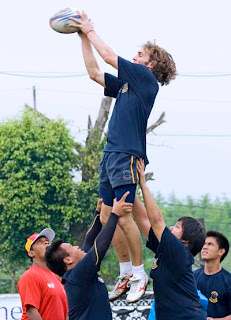 Cullen who has been at the forefront of developing rugby as a fun sport that everyone can enjoy is proud of what he has achieved since taking over the reins of the national team. Since 2005, the men’s team have won one Division higher with every campaign. They went undefeated in the Divison 2 in the Asian Rugby Football Union (ARFU) Under-19 division tournament in 2006 and won the Silver Medal in the 2007 Southeast Asian Games.

